# About
Name: Indian Digitals
Description: Full-funnel digital marketing, organic search, generative engine optimisation (GEO), B2B content, and high-performance digital experiences.
URL: https://www.indiandigitals.com/blog
# Navigation Menu
- Home: https://indiandigitals.superblog.click/
- Sample Page: https://indiandigitals.superblog.click/sample-page
- Search: https://indiandigitals.superblog.click/search
- Indian Digitals: https://indiandigitals.com/
# Blog Posts
## Is SEO Dead? No. Here's What AI Search Actually Changed
Author: Team Indian Digitals
Author URL: https://www.indiandigitals.com/blog/author/team-indian-digitals
Published: 2026-11-08
Meta Title: SEO is dead? Find our in this blog.
Meta Description: People say SEO is dead because of ChatGPT and AI search. It isn't. Here's what changed, what didn't, and what B2B brands should publish first.
URL: https://www.indiandigitals.com/blog/is-seo-dead-no-heres-what-ai-search-actually-changed
Yep, SEO is dead because we have AI now.
Or so you've heard.
Every year, someone says it. It has been "dying" since the 90s. First it was mobile. Then voice search. Then zero-click results. Now it's ChatGPT.
Here's the thing. People search in more places today. They use Google, ChatGPT, Claude, Perplexity, YouTube, TikTok and Reddit. A new channel doesn't kill the old one. It just adds one more place where your buyers can find you, or not find you.
So is SEO dead? No. But the way B2B buyers research has changed, and your website needs to keep up.
## **Is SEO dead in 2026?**
Short answer: no.
Google still handles roughly 90% of global search traffic, according to numbers from April 2026. Traditional search is not going anywhere overnight.
But it's also true that a big chunk of searches now end without a click. One 2026 estimate puts zero-click searches at around 60% of all searches. On mobile, it climbs even higher.
So the game changed. It didn't end.
I went through a bunch of Reddit threads on this topic while writing this. The mood is funny. Some folks are tired of the "is SEO dead" posts. They see them every single day. Others say it's more useful to say that Google-only SEO is fading, not SEO itself. I agree with that.
The people who say SEO is dead usually mean one of two things. Either the cheap tricks stopped working, or the traffic dropped because AI answers show up above the results. Both are real. Neither means you should stop publishing content.
## **Your buyers don't just Google anymore**
Here's what we notice on almost every discovery call with a B2B founder.
They know their product well. They know their buyers well. But they haven't noticed that marketing now has a whole new dimension.
Your buyers ask ChatGPT or Claude. And the numbers are hard to ignore:
- **51%** of B2B software buyers now start their research with an AI chatbot more often than with Google. A year earlier, it was 29%.
- **71%** rely on AI chatbots for software research, up from 60% before.
- **94%** of B2B buyers now use AI somewhere in the buying process, up from 89% the year before.
I can go on. But the point is simple.
That's not AI hype. That's a new buying channel.
And if you're a B2B company, your buyer might already have a shortlist before they ever visit your website. AI built that shortlist. Are you on it?
## **Where does AI get its answers?**
This is the part most people skip.
AI tools don't make things up from thin air. They learn from the web. And when they need fresh information, many of them quietly run searches behind the scenes. That means classic search still feeds AI answers, even when you never see it happen.
So where do the citations come from?
In our own learnings, around 15–25% of citations in AI answers to category, comparison and discovery questions point straight to a brand's own website. That's a big share, and it's the one slice you fully control.
The rest comes from other places. One 2026 analysis of US citations found Wikipedia and Reddit together made up over 25% of what ChatGPT cites. Reddit's share also swings a lot. One report showed it dropping 86% in just a few days in August. So you can't build your whole plan on any one outside platform.
Your own site is the stable ground. Build there first.
This is why we tell clients the same thing. There's no secret trick to winning AEO, GEO or LLMO, or whatever name we use this month. If you want a closer look at that side of things, here's how we approach [AI search optimization](https://indiandigitals.com/services/ai-search-optimization).
## **SEO, GEO, AEO, LLMO. What's the difference?**
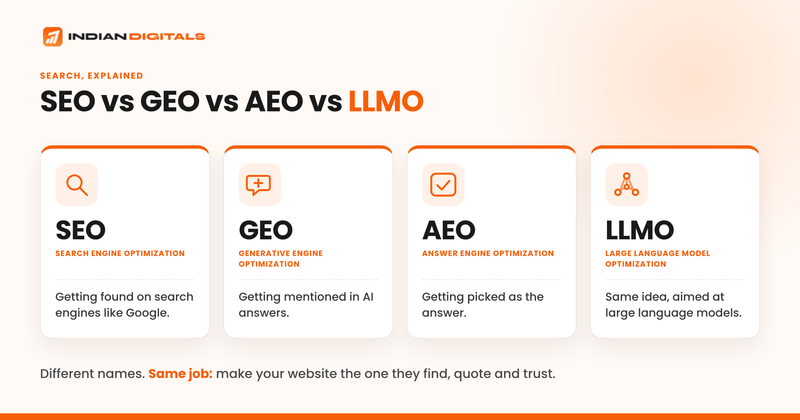
Not much, honestly.
- **SEO** is getting found on search engines like Google.
- **GEO** ( [generative engine optimization](https://www.indiandigitals.com/blog/generative-engine-optimization-geo-for-b2b-companies-a-practical-guide)) is getting mentioned in AI answers.
- **AEO** (answer engine optimization) is getting picked as the answer.
- **LLMO** is the same idea, aimed at large language models.
The names keep changing. The work underneath barely does. You need clear, useful, well-organized content on your own website. That's the whole job.
If you already do good [SEO](https://indiandigitals.com/services/seo), you're most of the way there. If you don't, AI search will make the gap more obvious.
## **A quick story**
A founder once told us, "We post on LinkedIn every day. Why aren't we showing up anywhere?"
We looked at his website. It had a homepage, an about page and a contact form. That's it.
His LinkedIn posts were good. But they were gone in a few days. And when we asked ChatGPT about his category, he wasn't mentioned once.
He wasn't ranking low. He simply didn't exist as far as search engines and AI were concerned.
We hear this a lot. Tons of B2B companies have zero content on their websites.
## **Why LinkedIn alone isn't enough**
Posting on LinkedIn is great. Keep doing it.
But a LinkedIn post has a short life. Most of its reach happens in the first day or two.
A good blog post can bring you traffic and leads for a year, or longer. It keeps working while you sleep. And it gives search engines and AI something to read.
Think of it this way. LinkedIn is where people meet you. Your website is where they, and AI, decide if you're real.
If you want both to work together, we help with [LinkedIn marketing](https://indiandigitals.com/services/linkedin-marketing) and [content strategy](https://indiandigitals.com/services/content-strategy) as one plan, not two separate ones.
## **An empty website means you don't exist**
Search engines and AI both learn about you from your own website.
If it's empty, they have nothing to learn from. As far as they're concerned, you don't exist.
That sounds harsh. But it's the most common reason a good B2B brand is missing from AI answers.
No content means no signals. No signals means no mentions. No mentions means your competitor gets the shortlist spot instead.
## **Try this today: the ChatGPT test**
This takes two minutes.
Open ChatGPT. Ask it about products or services in your industry. Use the kind of question your buyer would type, like "best project management tools for small agencies" or "top B2B content writing agencies."
Now check: does it mention you?
That's the biggest litmus test. Try it on Claude and Perplexity too, since each one answers a bit differently.
If you're not there, don't panic. Most brands aren't. Here's where to start.
## **What to publish first**
You don't need 200 posts. You need the right ones. Start with these four.
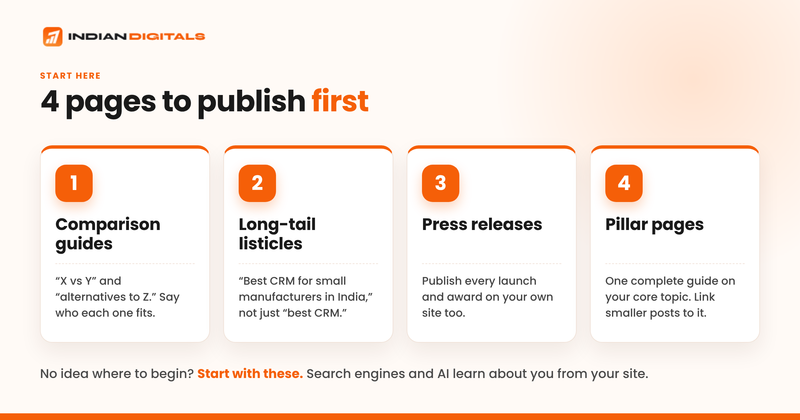What to publish on your website
### **1\. Comparison guides**
Buyers love comparing. "X vs Y" and "best alternatives to Z" are some of the most searched phrases in B2B. AI tools also lean on this kind of content for comparison questions.
Write honest ones. Say who each option is best for. Buyers (and AI) can tell when a page is just a sales pitch.
### **2\. Long-tail listicles**
Think "best CRM for small manufacturing companies in India" instead of "best CRM."
Long-tail keywords have less competition and clearer intent. People who search them are closer to buying. And AI questions are getting longer and more specific, so these pages match how people ask.
This is a big reason we focus on [B2B content writing](https://indiandigitals.com/services/b2b-content-writing) built around the exact phrases your buyers use.
### **3\. Press releases, published on your own site**
Most companies send a press release out and forget it. Then the news page on their site stays empty.
Publish it on your own website too. Every launch, award, partnership and funding update becomes a page that tells search engines and AI who you are and what you do.
### **4\. Pillar pages**
A pillar page is one big, complete guide on a core topic. Then you link smaller posts to it.
For example, if you sell accounting software, your pillar page could be "The Complete Guide to Accounting Software for Small Business." Your comparison guides and listicles all point back to it.
This tells search engines you know the topic deeply. It also gives AI one solid page to pull from.
Need help planning this? Our [content writing](https://indiandigitals.com/services/content-writing) team builds these libraries from scratch.
## **Quick mistakes to avoid**
- **Writing thin content.** A 300-word post with no real answer won't help anyone. Go deep.
- **Chasing every new acronym.** Don't rebuild your strategy each time a new term goes viral.
- **Ignoring local searches.** If you serve a specific city, [local SEO](https://indiandigitals.com/services/local-seo) still matters a lot, and AI tools now recommend local businesses too.
- **Only posting off-site.** Rented space is fine. But own your base.
- **Publishing once and stopping.** Content libraries grow over time. A few strong posts a month beat a burst of ten and then nothing.
## **A simple plan for the next 30 days**
1. Run the ChatGPT test and write down what you find.
2. List 10 questions your buyers ask on sales calls.
3. Turn each one into a blog post or comparison page.
4. Publish your last three press releases on your own site.
5. Pick one pillar topic and start writing it.
6. Check back in 60 days and run the test again.
That's it. No tricks. Just consistent work on the one asset you fully own.
[](https://www.indiandigitals.com/contact/)
## FAQs
Q: What is the difference between SEO and AI SEO?
A: SEO aims to rank your pages in search results. AI SEO, also called GEO or AEO, aims to get your brand mentioned or cited in AI answers. The core work is the same: clear, useful content on your own site.
Q: How do I get my business mentioned in ChatGPT?
A: Publish helpful content on your website, like comparison guides, long-tail listicles and pillar pages. Keep your brand details consistent across the web. Then test regularly by asking ChatGPT questions your buyers would ask.
Q: How long does SEO take to work?
A: Usually a few months to see early movement, and longer for big results. It depends on your competition and how much quality content you publish.
Q: Is SEO dead because of AI?
A: No. AI changed how people search, but search engines are still huge, and AI tools often rely on web content (and sometimes live searches) to answer. Good SEO content helps you in both places.
Q: Is blogging still worth it for B2B in 2026?
A: Yes. A strong blog post can send traffic and leads for a year or more, while a social post fades in days. Blogs also feed both search engines and AI tools.
---
This blog is powered by Superblog. Visit https://superblog.ai to know more.
---
## Generative Engine Optimization (GEO) for B2B Companies: A Practical Guide
Author: Team Indian Digitals
Author URL: https://www.indiandigitals.com/blog/author/team-indian-digitals
Published: 2026-10-29
Category: AI Search & GEO
Category URL: https://www.indiandigitals.com/blog/category/ai-search-and-geo
Meta Title: Generative Engine Optimization (GEO) for B2B Companies
Meta Description: Easy guide - learn how generative engine optimization (GEO) helps B2B companies get mentioned in AI search, earn citations, improve visibility, and reach buyers.
URL: https://www.indiandigitals.com/blog/generative-engine-optimization-geo-for-b2b-companies-a-practical-guide
SEO is dead. AI has replaced Google. There is no point investing in website content anymore.
You have probably heard some version of this argument. People have been declaring [SEO dead for years](https://www.indiandigitals.com/blog/is-seo-dead-no-heres-what-ai-search-actually-changed), and the arrival of AI search has given them another reason.
But look at how people actually buy things.
The rise of quick-commerce apps has not stopped people from shopping on Amazon. People still use Amazon for products they want to compare, research, or order in bulk. They use quick-commerce apps when they need groceries or other essentials delivered quickly. A new channel has changed where people shop for certain things. It has not eliminated the old one.
Search is following a similar pattern. People still use Google, but they also ask ChatGPT, Perplexity, Gemini, Claude, and other AI tools to research products, compare vendors, and get recommendations.
The data already shows why businesses should pay attention:
A [Pew Research Center study](https://www.pewresearch.org/short-reads/2025/07/22/google-users-are-less-likely-to-click-on-links-when-an-ai-summary-appears-in-the-results/) analyzed the browsing activity of 900 US adults. It found that users clicked a traditional search result in 8% of visits when Google displayed an AI summary, compared with 15% when no AI summary appeared. Only 1% of visits to pages with an AI summary resulted in a click on a link within the summary itself.
That finding has an important limitation: it measures US Google users in March 2025, not every search engine or B2B buying journey. Still, it shows that AI-generated answers can change how people interact with search results.
Google is also investing heavily in this behavior. In June 2026, Google reported that AI Overviews had more than 2.5 billion monthly active users and AI Mode had surpassed one billion monthly users. These figures come from Google's own reporting, but the scale of adoption is difficult to ignore.
For B2B companies, this creates a new question.
When a potential customer asks an AI tool to recommend a software vendor, website development agency, manufacturing partner, or consulting firm, does your company appear in the answer?
If it doesn't, you may be missing an opportunity to enter the buyer's shortlist before they visit your website.
This is where generative engine optimization (GEO) for B2B companies comes in.
GEO helps businesses improve their chances of being discovered, mentioned, and cited in AI-generated answers. It builds on much of the work already associated with SEO, including useful website content, technical accessibility, and a credible presence across the web.
The goal is to make your company easier for search engines and AI systems to find, understand, and recommend when it fits what a buyer needs.
## **What is generative engine optimization (GEO)?**
Generative engine optimization (GEO) is the process of improving a brand's visibility in AI-generated responses across platforms such as ChatGPT, Perplexity, Gemini, and AI-powered search experiences.
Traditional SEO generally aims to improve a website's visibility in search results. GEO focuses on whether AI systems mention a company, recommend its products or services, or cite its website when answering relevant questions.
For example, imagine a B2B SaaS company selling inventory management software.
A buyer might search Google for "inventory management software for distributors." The company wants its website to rank for that query.
The same buyer might ask ChatGPT:
"Which inventory management platforms work best for mid-sized distributors in India, and what should I compare before choosing one?"
The AI response might explain the main selection criteria, name several vendors, compare their features, and link to supporting sources.
GEO aims to improve the company's chances of appearing in that second experience, too.
The two activities overlap. Google says its AI search experiences rely on its existing search and quality systems, and that foundational SEO practices remain relevant. Its [official guide to AI search optimization](https://developers.google.com/search/docs/fundamentals/ai-optimization-guide) recommends useful, original content, a clear technical structure, and established SEO practices.
GEO is not a guarantee of inclusion in AI responses. Results vary by platform, prompt, location, and time.
### **GEO vs. SEO: What is the difference?**
**Area**
**Traditional SEO**
**Generative engine optimization**
Primary goal
Improve visibility in search results
Improve visibility in AI-generated answers
Common outcomes
Rankings, organic clicks, conversions
Brand mentions, citations, referrals, assisted conversions
Content focus
Match search intent and satisfy the query
Answer questions clearly and provide information worth citing
Authority signals
Relevant links, useful content, reputation
Website credibility, relevant third-party references, consistent brand information
Measurement
Search impressions, rankings, clicks, conversions
AI mentions, citations, AI referrals, search performance, conversions
Technical foundation
Crawlability, indexability, site structure
The same foundation, plus monitoring how AI platforms retrieve and present information
These are differences in emphasis, not completely separate disciplines. A strong SEO program can support GEO, and a GEO program that ignores technical SEO is likely to struggle.
## **Why B2B companies need GEO**
B2B buying decisions often involve multiple stakeholders, detailed research, and significant financial commitments. Buyers may compare several vendors before agreeing to a sales call.
AI tools can help them narrow their options before contacting any of those vendors.
Consider a manufacturing company looking for a new ERP implementation partner. Its leadership team might ask an AI assistant to identify experienced providers, compare implementation approaches, explain common project risks, or suggest questions to ask during vendor evaluations.
A vendor that appears in those answers has an opportunity to enter the buyer's consideration set early.
A competitor that never appears may have to work harder to earn that attention later.
### **AI search can influence the shortlist before a sales conversation**
B2B companies invest heavily in websites, case studies, comparison pages, and educational content because buyers research vendors independently.
AI adds another place where that research can happen.
Your content may help an AI system explain a problem, compare solutions, or support a recommendation. Your company might also be named directly, even when the buyer never clicks through to your website.
That means website traffic alone may not tell the whole story.
A prospect could discover your brand in an AI answer, visit your website later through a branded Google search, and eventually contact your sales team. The original AI interaction might not appear as the last source in your analytics report.
This is one reason to measure AI visibility alongside traditional organic search performance.
### **AI visibility does not make website traffic irrelevant**
There is a temptation to treat every AI mention as a win. But a mention has limited commercial value if it doesn't reach the right audience or influence a buying decision.
Your website still has important jobs to do. It explains your services, demonstrates expertise, presents evidence, answers objections, and gives interested buyers a way to contact you.
It also provides information that AI systems may retrieve and cite.
In our own observations of category, comparison, and discovery prompts, roughly 15% to 25% of citations have pointed directly to the brands' own websites. This is an observed working range, not a universal industry benchmark. Citation patterns vary significantly across prompts, industries, and AI platforms.
The practical lesson is to keep investing in your website while expanding your visibility beyond it.
## **How do AI search engines choose which brands to mention?**
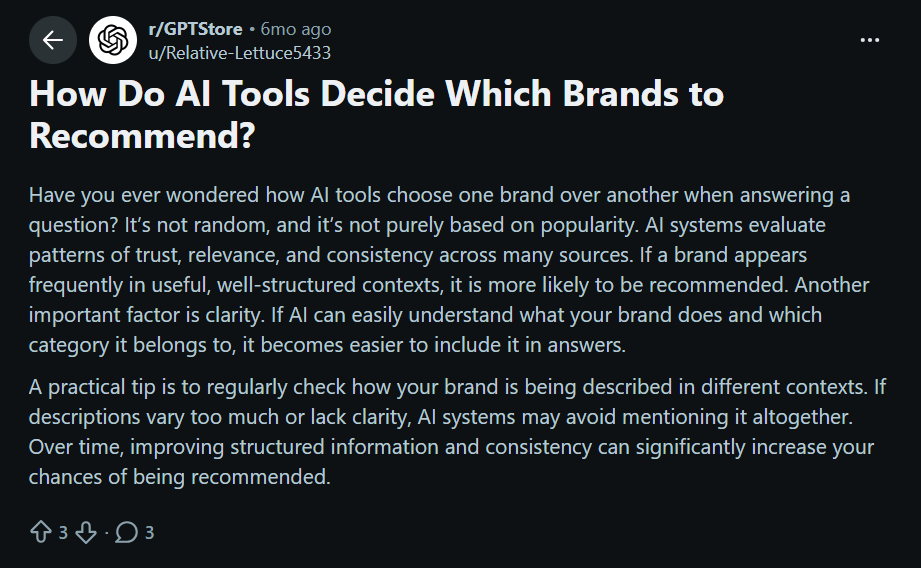Reddit used to be (still is kind of) the hottest hack to appear on AI. But AEO+SEO is a long-term game
There is no single GEO ranking formula that applies to every AI platform.
Some AI experiences retrieve current web pages to ground their answers. Others may draw on different search systems, model knowledge, or combinations of sources. Their responses can change even when the question stays the same.
Still, several areas deserve attention when you're trying to improve your brand's chances of being discovered and cited.
### **1\. Clear brand identity and entity information**
AI systems need to distinguish your company from other businesses and understand what it does.
If your website describes you as a software development company, LinkedIn calls you a digital transformation consultancy, and directory listings describe you as an IT staffing firm, your positioning becomes harder to interpret.
[](https://nick-nolan.medium.com/a-growing-list-of-free-do-follow-backlinks-f07a0ab1d7c0) Check out this awesome Nick Nolan's post on Medium on easy do-follow backlink building
Keep important information consistent across your website, company profiles, and relevant business directories.
Make it easy to establish:
- Your company's official name and website.
- The products and services you sell.
- The industries and customers you serve.
- Your geographic markets.
- Your leadership and relevant expertise.
- Your relationships with products, brands, and other organizations.
Consistency alone will not make an AI system recommend you. It helps establish a more coherent picture of your business.
### **2\. Useful content that answers real buyer questions**
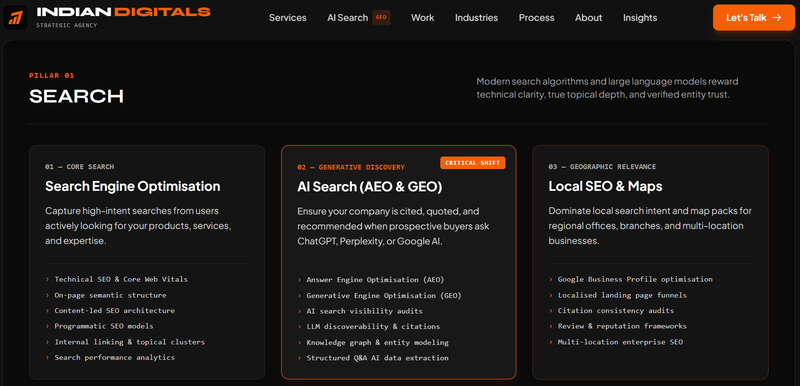Whether it is a blog post or homepage/ webpage copy — your writing needs to be simple enough to communicate exactly what you're selling
A page that says your company provides "world-class digital solutions" gives a buyer little information to evaluate.
A page explaining how you handle a complex ERP migration, which systems you support, what the implementation involves, and what clients should expect provides much more substance.
Specific, useful information gives readers something to evaluate and gives retrieval systems material that may support a relevant answer.
For B2B companies, this means creating content around actual buying questions, including:
- Which solution fits a particular business model?
- What does implementation involve?
- How much does the service cost?
- What should a buyer compare between vendors?
- Which technical limitations should buyers understand?
- What results has a provider achieved in comparable projects?
Write answers you can support. Avoid inventing statistics or making claims your team cannot substantiate.
### **3\. Independent references and brand mentions**
Your own website tells readers what you say about your company. Third-party sources can help them assess that information.
Relevant sources may include industry publications, credible directories, partner websites, customer case studies, professional communities, and discussions where people compare vendors.
Semrush's [AI search visibility research](https://www.semrush.com/blog/ai-search-visibility-study-findings/) has examined how AI systems cite sources across industries, including the role of community-generated content.
That is a useful reminder to look beyond your website when building visibility.
The objective is to earn genuine references through useful work, customer relationships, original research, and participation in relevant communities. Publishing large volumes of low-quality mentions just to influence AI responses is unlikely to be a sound long-term strategy.
### **4\. Original evidence and expertise**
If five websites repeat the same generic explanation of a topic, an additional copy contributes little.
Original research, first-hand experience, customer examples, technical explanations, and clear points of view give your content a reason to exist.
For example, a B2B web development agency could publish a detailed case study explaining how it improved a client's lead generation process. The page could describe the original problem, the decisions made, the implementation, and the measurable outcome.
[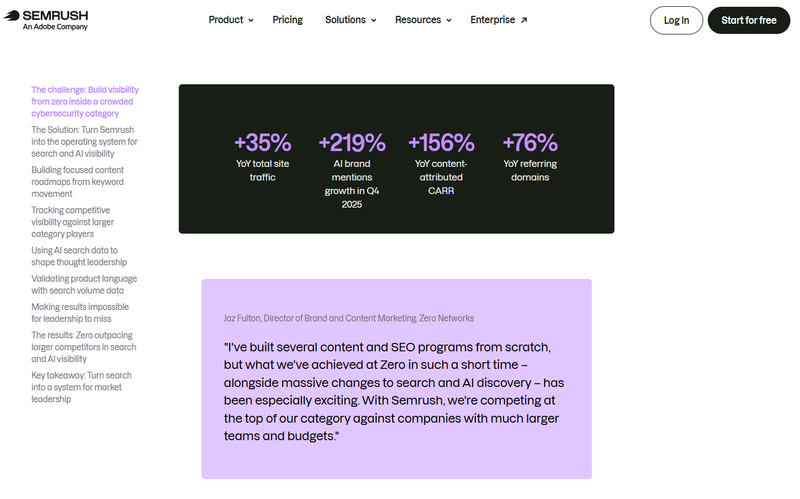](https://www.semrush.com/company/stories/zero-networks/) This case study on semrush is a good example of how to write a great case study
That is more useful than a generic article about the benefits of modern websites.
Google's guidance for AI search specifically recommends content that adds unique value instead of simply restating information available elsewhere.
## **How to build a GEO strategy for B2B companies**
A GEO strategy should begin with the questions your potential customers ask, the evidence your business can provide, and the pages you already have.
You do not need to publish hundreds of new articles or create a separate page for every possible prompt.
Start with the content and technical foundation you already own.
### **Step 1: Audit your current AI visibility**
Before changing your website, establish whether AI tools already mention your brand.
Choose the AI platforms most relevant to your audience. For a typical B2B company, you might start with ChatGPT, Perplexity, Gemini, and Google's AI search experiences.
Create a list of 10 to 20 prompts based on your buyers' research process.
For example, a B2B software company might test:
- Best ERP software for mid-sized manufacturers in India.
- Top ERP implementation partners for manufacturing companies.
- ERP implementation costs for a 200-person company.
- How to compare ERP implementation vendors.
- Common problems with ERP migration.
- Alternatives to \[competitor name\].
- Best software development companies for B2B SaaS startups.
Run the prompts on each platform and record the results.
Track whether your company is mentioned, whether your website is cited, which competitors appear, and which sources the answer references.
Repeat the tests over time. A single response is not a reliable measure of visibility, and identical prompts can produce different answers.
### **Step 2: Identify the queries that influence buying decisions**
A broad informational query can introduce a buyer to a problem. A comparison query can help the buyer decide which vendors deserve consideration.
Both can be useful, but they serve different purposes.
**Buyer stage**
**Example query**
**Content to create**
Problem awareness
Why do manufacturing companies struggle with inventory visibility?
Educational guides and problem-focused articles
Solution research
How does ERP improve inventory management?
Solution pages and implementation guides
Vendor discovery
Best ERP implementation partners in India
Category pages, directories, and comparison content
Vendor evaluation
How to compare ERP implementation companies
Comparison guides, case studies, and evaluation checklists
Purchase decision
What does an ERP implementation partner charge?
Pricing pages, service details, and buying guides
For B2B companies, comparison and evaluation content deserves particular attention because it answers questions buyers may ask shortly before contacting vendors.
Build a list of these queries using customer interviews, sales calls, support conversations, keyword research, competitor pages, and your AI visibility audit.
### **Step 3: Improve the website pages you already have**
Start with your core service pages, product pages, case studies, and existing articles that support commercial queries.
Make sure each important page explains its subject directly.
A B2B service page should clearly communicate:
- What the company provides.
- Who the service is designed for.
- Which business problems it addresses.
- How the engagement works.
- What the buyer receives.
- What evidence supports the company's claims.
- What the buyer should do next.
For example, a page targeting "B2B website development company" should explain the agency's B2B experience, website development process, relevant technical capabilities, and results from comparable projects.
A short, direct answer near the beginning of a section can help readers understand the topic quickly. Supporting details can then explain the reasoning, limitations, and examples.
Do not remove useful depth just to make every paragraph short. Buyers evaluating expensive services often need detailed information.
### **Step 4: Create content that deserves to be cited**
A strong GEO content strategy goes beyond publishing generic definitions.
Build articles around questions that your company can answer with genuine experience or useful research.
For example:
**For a B2B SaaS company**
- ERP implementation costs: A breakdown of common cost components.
- ERP vs. standalone inventory software for distributors.
- How to evaluate an ERP implementation partner.
- Common causes of ERP project delays.
**For a B2B marketing agency**
- How to evaluate an SEO agency for a complex B2B business.
- GEO vs. SEO: What should B2B companies measure?
- How to build a website that supports enterprise sales.
- How to compare B2B website development companies.
**For an industrial manufacturer**
- How to choose a supplier for a specific application.
- Technical specifications buyers should compare.
- Common installation and maintenance considerations.
- Questions procurement teams should ask before requesting a quote.
Where possible, include first-hand observations, original data, named experts, customer examples, and links to supporting evidence.
A good article should help someone make a decision even if they never contact your company.
### **Step 5: Build topic clusters and internal links**
Your website should help readers move from a general question to a more specific answer.
Suppose your company sells B2B website development services. You might have a core service page supported by articles on website costs, platform selection, conversion optimization, migration, and vendor evaluation.
Link related articles to the main service page where it helps readers. Link between articles when one provides useful background for another.
This structure helps visitors discover relevant information and gives search engines a clearer view of how your pages relate to one another.
Avoid creating dozens of near-identical pages for slightly different AI prompts. Publish a new page when it answers a distinct question or serves a meaningful audience need.
### **Step 6: Earn relevant third-party mentions**
Your website is only one part of your online presence.
Find the publications, communities, partner sites, and business directories that your buyers already use.
Depending on your industry, useful opportunities might include:
- Credible industry directories.
- Trade publications and specialist websites.
- Partner and integration listings.
- Customer case studies hosted by clients or partners.
- Expert interviews and original research.
- Relevant professional communities.
For example, a B2B software company could publish original findings about implementation challenges and share them with relevant industry publications. An agency could contribute a useful technical analysis to a publication read by its target customers.
The objective is to build a credible reputation in places that matter to your audience. Relevance and the quality of the reference are more important than collecting mentions indiscriminately.
### **Step 7: Review the technical foundation**
AI visibility still depends, in many cases, on systems being able to discover and retrieve information from the web.
Review your website for:
- Crawlability and indexability.
- Important pages blocked by robots.txt or other access restrictions.
- Correct canonical tags and redirects.
- Useful internal links.
- Accessible text content.
- Mobile usability and page performance.
- Accurate page titles and meta descriptions.
- Appropriate structured data.
- Consistent business information.
Check important pages in Google Search Console to confirm whether they are indexed and to identify technical problems.
Google's official documentation says pages must meet the relevant Search eligibility requirements to appear as supporting links in its AI search experiences. It also says there are no additional technical requirements specifically for AI Overviews and AI Mode beyond the established Search requirements.
### **Step 8: Use structured data where it fits**
Structured data, often implemented using Schema.org vocabulary, helps search engines interpret information about a page or entity.
For a B2B website, appropriate implementations may include:
- Organization for company information.
- Article or BlogPosting for editorial content.
- BreadcrumbList for breadcrumb navigation.
- Product for eligible product pages.
- Service where the implementation is appropriate to the content.
Use FAQPage markup only where it is appropriate for the page and supported by the relevant platform's current guidelines. Do not assume FAQ schema will automatically improve AI visibility.
The markup must accurately reflect the visible page content. Validate it with Google's [Rich Results Test](https://search.google.com/test/rich-results) where applicable and the [Schema Markup Validator](https://validator.schema.org/).
Structured data helps describe content. It does not guarantee that a page will be cited, and Google explicitly says there is no special schema markup required to appear in its AI search features.
### **Step 9: Make your company information consistent**
Check your website's About page, company LinkedIn profile, relevant business directories, and partner listings.
Use a consistent company name, website URL, service description, and other factual details. Keep profiles current and make sure they link to the correct official website.
Where appropriate, connect the relevant profiles through sameAs properties in your Organization structured data.
This is a useful way to express relationships between your organization and its official profiles. It is not a shortcut that guarantees AI recommendations.
### **Step 10: Measure results and refine the strategy**
GEO should be treated as an ongoing process.
Review your AI visibility tests, referral traffic, search performance, and business outcomes regularly. Identify which pages appear in answers, which sources are cited, and which buyer questions you still struggle to answer.
Use those findings to update existing content, improve technical accessibility, and develop new material where there is a genuine gap.
Avoid judging the entire strategy by one AI response or one week of traffic.
## **How to track AI visibility for your B2B brand**
You cannot improve what you never measure. But AI search introduces a measurement problem: a brand mention, a website citation, an impression, and a click are four different things.
For a useful GEO measurement system, separate AI visibility into three areas:
1. Referral traffic from AI platforms.
2. Visibility in Google's AI search experiences.
3. Brand mentions and citations inside AI-generated answers.
Each tells you something different about how potential buyers find your business.
### **1\. Track website visits from ChatGPT, Perplexity, and other AI tools**
This is the most straightforward place to start because you can measure actual visits to your website.
When someone clicks a link in an AI-generated answer and lands on your website, the visit may appear in Google Analytics 4 (GA4), depending on how the platform passes referral information and how the session is attributed.
You can group these visits into a dedicated AI traffic channel.
#### **How to create an AI referral channel in GA4**
Google Analytics supports custom channel groups with rules based on traffic-source dimensions. You can follow Google's [official instructions for custom channel groups](https://support.google.com/analytics/answer/13051316).
1. Open GA4 and go to **Admin**.
2. Open **Data display** and select **Channel groups**.
3. Create a new channel group or copy an existing one.
4. Add a channel named AI assistants.
5. Create a condition using the source dimension and the matches regex operator.
6. Enter a regular expression that matches the AI platforms you want to track.
7. Save the channel group and make sure the AI channel is ordered appropriately relative to other channels.
8. Open **Reports → Acquisition → Traffic acquisition** and use your custom channel group to inspect the traffic.
You can start with this regular expression:
.\*(chatgpt\|openai\|perplexity\|claude\|anthropic\|gemini\|copilot\|grok\|deepseek\|meta\\.ai\|mistral\|poe\\.com\|you\\.com\|phind\|kimi\|qwen).\*
Adjust the expression as new platforms become relevant. Google's own documentation provides a similar example for grouping AI assistant traffic.
#### **What should you measure?**
Track more than the number of sessions.
**Metric**
**What it tells you**
Sessions from AI platforms
How many visits GA4 attributes to AI sources
Engaged sessions
How often those visits meet GA4's engagement criteria
Landing pages
Which pages receive AI referral traffic
Key events
Whether visitors complete actions you've configured in GA4
Conversions and leads
Whether AI-referred visitors become business opportunities
Landing-page engagement
Whether visitors find the content useful after arriving
For B2B companies, the landing-page report can be particularly useful. If visitors repeatedly arrive at a specific comparison article or service page from AI platforms, investigate what makes that page relevant and whether it helps them move toward a purchase.
**One limitation:** GA4 measures identifiable visits, not every interaction with an AI platform. If someone sees your company mentioned in ChatGPT and later types your brand name into Google, the original AI interaction may not appear in the attribution data.
Treat AI referral traffic as a measurable part of your visibility, not the complete picture.
### **2\. Measure visibility in Google AI Overviews and AI Mode**
Google's AI search experiences are different from referrals coming from ChatGPT or Perplexity.
A user may see your website cited in an AI-generated Google response without clicking through to it.
That means you should examine Google Search performance separately from GA4 referral traffic.
Open [Google Search Console](https://search.google.com/search-console/) and review the performance reporting available for your property. Google introduced reporting for generative AI search experiences, including impressions and information about pages appearing in AI responses, with availability dependent on the reporting features enabled for the property.
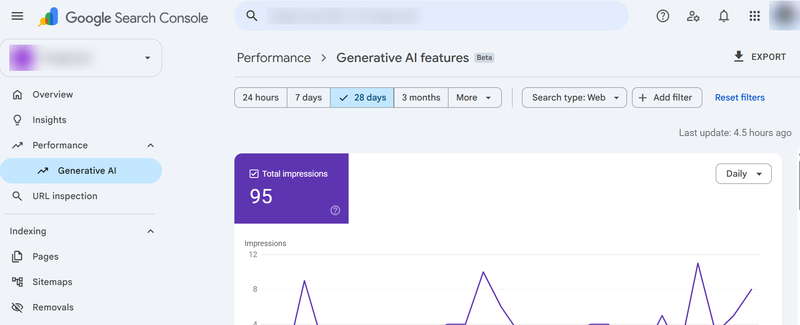
Google search console Generative AI feature
Use the report to investigate which pages receive visibility, which search queries are associated with that visibility where query data is provided, and how performance changes over time.
Compare those findings with your existing organic search performance.
For example, an article might gain visibility in AI search without a corresponding increase in website clicks. That does not automatically mean the article has failed. It means you need to understand whether the additional visibility is reaching relevant buyers and whether other metrics, such as branded searches or qualified leads, change over time.
Do not assume every AI Overview impression represents a unique person seeing your brand. Search Console metrics follow Google's reporting definitions, which may differ from the visibility measures used by third-party tools.
### **3\. Track brand mentions and citations inside AI-generated answers**
This is the hardest part of GEO measurement.
AI platforms do not all provide marketers with a complete, standardized report showing every time a company was mentioned in a response.
You can, however, run a structured visibility study.
Start by creating a fixed set of prompts related to your category, competitors, services, and buying decisions. Run those prompts on your selected platforms and record the answers.
Track these metrics:
**Metric**
**How to measure it**
Brand mention rate
Percentage of tested responses that mention your company
Citation rate
Percentage of tested responses that cite your website
Competitor presence
How often competitors appear in the same responses
Source visibility
Which domains are cited most often
Recommendation position
Where your company appears in a response, where meaningful
Prompt coverage
Number of relevant buyer questions for which your company appears
For example, if your brand appears in 12 out of 40 responses, your observed brand mention rate is 30%.
That does not mean 30% of all AI users see your brand. It means your brand appeared in 30% of the responses in that particular test set.
Repeat the tests with the same prompts, platforms, and recording rules. Keep track of the date, because results can change as models, search indexes, and responses change.
#### **Can tools like Semrush track AI visibility?**
Yes. AI visibility tools can help automate prompt testing and report which brands and sources appear in sampled AI answers.
Semrush's [AI Visibility Index methodology](https://ai-visibility-index.semrush.com/methodology) distinguishes brand mentions, domain citations, and brand co-occurrence. These are useful measures for understanding how brands appear across AI platforms.
However, third-party visibility scores should be interpreted according to each tool's methodology. A platform that runs a set of prompts and records responses measures visibility within that sample. It does not necessarily measure every response seen by real users.
Use these tools to monitor patterns and compare competitors, then validate the commercial value through your own website analytics, Search Console data, and lead records.
## **Common GEO mistakes B2B companies should avoid**
A GEO strategy can become expensive if teams focus on tactics that sound technical but do little for buyers.
### **Treating GEO as a replacement for SEO**
[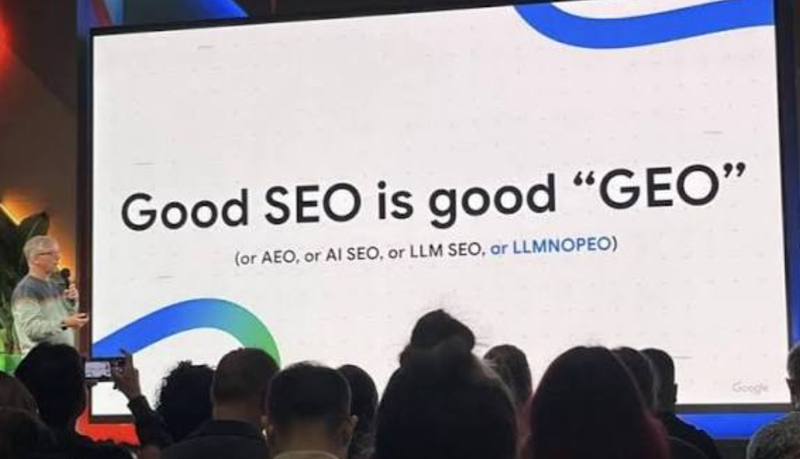](https://business.google.com/in/think/search-and-video/ai-search-era-brand-authority-strategy/) This is true especially for SEO fundamentals but that's not the whole story
Google explicitly recommends continuing established SEO practices for its AI search experiences. Crawlability, useful content, indexing, and a sound website structure remain relevant.
Keep your SEO program running while you test additional ways to earn AI visibility.
### **Publishing generic AI-generated articles at scale**
Producing more pages does not automatically produce more citations.
If your articles repeat information that is already widely available, they give buyers little reason to trust your expertise. Publish content that answers real questions and adds something useful.
AI can assist with research, outlining, and editing, but your team should verify facts and contribute genuine experience.
### **Assuming schema guarantees citations**
Structured data helps describe your content and organization. It does not force AI systems to mention your business.
Use the markup that fits your pages, validate it, and spend time improving the actual information buyers need.
### **Ignoring third-party sources**
Your website is important, but buyers also encounter brands through publications, reviews, professional communities, partner sites, and directories.
Develop a credible presence where your customers already look for information. Avoid buying large volumes of irrelevant mentions simply to influence AI answers.
### **Measuring mentions without measuring business outcomes**
A company can appear frequently in AI responses without receiving qualified leads.
Monitor visibility alongside referral traffic, branded search demand, inquiries, and sales opportunities. The commercial value of AI visibility depends on the audience reached and the decisions it influences.
## **A 30-day GEO action plan for B2B companies**
You do not need a large team or a new content operation to begin. Start with a manageable set of tasks and expand based on what you learn.
**Week**
**Priority**
**Actions**
Week 1
Establish a baseline
Test 10 to 20 buyer prompts, record brand mentions and citations, and identify competitors that appear frequently
Week 2
Fix the foundation
Review indexing, internal links, service pages, company information, and appropriate structured data
Week 3
Improve content
Update two or three important pages and create one useful comparison article or case study
Week 4
Extend measurement
Set up AI referral tracking in GA4, review Search Console reporting, repeat prompt tests, and document the results
At the end of the month, you should have a baseline, a list of content gaps, a stronger set of priority pages, and a repeatable measurement process.
You may not see a dramatic increase in AI mentions within 30 days. Search discovery, indexing, and changes in third-party visibility can take time. The purpose of the first month is to establish a process you can continue improving.
## **Frequently asked questions about GEO for B2B companies**
### **Is SEO dead because of AI search?**
No. AI is changing how people discover information, but traditional search remains part of that process. Google says its AI search experiences rely on existing search systems and established SEO practices. B2B companies should continue investing in organic search while measuring visibility across additional AI platforms.
### **What is the difference between GEO and AEO?**
Generative engine optimization (GEO) generally refers to improving a brand's visibility in generative AI responses. Answer engine optimization (AEO) usually emphasizes providing answers that answer engines can surface directly. The terms overlap, and there is no universally enforced distinction between them.
### **Does GEO work for small B2B companies?**
Yes. Smaller companies can focus on a narrow set of services, industries, and buyer questions. Detailed service pages, original case studies, accurate company information, and useful specialist content can help establish relevance without requiring a large publishing budget. Results are not guaranteed, and visibility varies by category and platform.
### **How long does GEO take to show results?**
There is no reliable universal timeline. Some pages may already be eligible for retrieval, while others need technical fixes, stronger content, or greater visibility across relevant sources. Establish a baseline and review trends over several weeks and months instead of judging success from isolated responses.
### **Do I need a separate website for GEO?**
No. Your existing website is usually the right place to start. Improve the pages you already have, publish content for meaningful buyer questions, and make sure search engines can access the important information. A separate GEO website would generally add unnecessary complexity.
### **Is llms.txt necessary for GEO?**
No, not for Google AI search. Google's current guidance says it does not use llms.txt as a special mechanism for improving visibility in Google Search or its generative AI features. Other systems may handle files differently, but creating one should not take priority over useful content and established technical SEO.
### **Can I guarantee that ChatGPT or Gemini will recommend my company?**
No. AI responses vary with the prompt, platform, context, and sources retrieved. You can improve your website's accessibility, provide useful evidence, build a credible reputation, and monitor your visibility, but no legitimate GEO strategy can guarantee a particular recommendation.
## **Final thoughts: Build visibility wherever your buyers search**
B2B companies do not need to abandon SEO to invest in GEO.
Think about how your customers research a purchase. Some will use Google to find service providers. Others will ask AI tools to explain their options or compare vendors. Many will move between search engines, AI assistants, professional communities, and company websites before making a decision.
Your website remains central to this process. It explains what you sell, provides evidence of your expertise, and gives buyers a place to evaluate your business. It can also become a source that AI systems cite when answering relevant questions.
Start by improving the pages that influence buying decisions. Add original evidence, answer specific customer questions, keep your technical foundation sound, and build a credible presence across relevant third-party sources.
Then measure what changes.
The aim is straightforward: make your company easier to find, easier to understand, and easier for the right buyers to consider, whether they discover you through Google or an AI-generated answer.
## **Want to improve your brand's visibility in AI search?**
Indian Digitals helps businesses improve their organic search visibility through SEO, content marketing, and generative engine optimization (GEO).
We can help you identify where your brand appears in AI-generated answers, find gaps in your website content, and build a strategy to improve your chances of being discovered by potential customers across search engines and AI platforms.
[Talk to Indian Digitals about your AI search visibility](https://indiandigitals.com/)
## **Sources and further reading**
1. [Google Search Central: Optimizing your website for generative AI features in Google Search](https://developers.google.com/search/docs/fundamentals/ai-optimization-guide)
2. [Pew Research Center: Google users are less likely to click on links when an AI summary appears in the results](https://www.pewresearch.org/short-reads/2025/07/22/google-users-are-less-likely-to-click-on-links-when-an-ai-summary-appears-in-the-results/)
3. [Google Analytics Help: Custom channel groups](https://support.google.com/analytics/answer/13051316)
4. [Semrush: AI Visibility Index methodology](https://ai-visibility-index.semrush.com/methodology)
5. [Semrush: How AI search works and findings from its AI visibility study](https://www.semrush.com/blog/ai-search-visibility-study-findings/)
## FAQs
Q: What is generative engine optimization (GEO)?
A: Generative engine optimization (GEO) is the process of improving a brand's visibility in AI-generated answers on platforms such as ChatGPT, Google AI Overviews, Gemini, and Perplexity. It involves creating useful website content, improving technical SEO, building brand credibility, and providing information AI systems can discover and cite.
Q: What is the difference between GEO and SEO?
A: SEO focuses on improving a website's visibility in traditional search results, while GEO focuses on increasing the chances of a brand being mentioned or cited in AI-generated answers. Both rely on useful content, technical accessibility, and credibility. B2B companies should combine SEO and GEO to reach buyers across search engines and AI platforms.
Q: Why is GEO important for B2B companies?
A: GEO can help B2B companies reach potential customers who use AI tools to research solutions, compare vendors, and create shortlists. Appearing in relevant AI-generated answers can introduce a business to buyers before they visit its website or contact its sales team.
Q: How can I get my business mentioned in ChatGPT and Google AI Overviews?
A: Make sure your website is accessible to search engines and contains accurate, useful information about your business. Publish detailed service pages, original research, case studies, and content that answers buyer questions. Build credible third-party references and monitor relevant prompts to understand when your brand appears. No specific tactic guarantees a mention.
Q: Does GEO replace traditional SEO?
A: No. GEO complements SEO by extending your visibility into AI-generated answers. Technical SEO, crawlability, indexing, internal links, and helpful website content remain important. Businesses should continue improving organic search performance while tracking brand mentions, citations, and referral traffic from AI platforms.
Q: How do I measure AI search visibility for my business?
A: Measure AI visibility by tracking brand mentions and website citations across a consistent set of prompts on platforms such as ChatGPT, Gemini, and Perplexity. Use Google Analytics 4 to monitor identifiable referral traffic from AI platforms and Google Search Console to review available search performance data. Third-party tools can help automate prompt testing.
Q: What type of content helps with generative engine optimization?
A: Content that directly answers relevant questions and provides useful evidence is a strong starting point. For B2B companies, this includes service pages, comparison articles, case studies, implementation guides, pricing explanations, original research, and technical documentation. Clear explanations and verifiable facts help readers evaluate your expertise.
Q: How long does GEO take to show results?
A: There is no fixed timeline for GEO results. Website changes may take time to be discovered and indexed, while brand mentions can vary between prompts and platforms. Establish a baseline, improve important pages, and monitor visibility and qualified traffic over several weeks and months.
Q: What is Indian Digitals?
A: Indian Digitals is a digital marketing agency based in Uttar Pradesh, India. Its services include SEO, content writing, AI search optimization, paid media, social media marketing, website development, local SEO, and B2B content strategy. Indian Digitals helps businesses strengthen their online presence and reach relevant audiences through digital marketing.
Q: Does Indian Digitals offer GEO and AI SEO services?
A: Indian Digitals provides AI search optimization alongside SEO and content marketing services. GEO work can include assessing brand mentions in AI-generated answers, identifying website content gaps, improving important service pages, and developing content that addresses buyer questions. The specific scope depends on the company's goals and current search visibility.
Q: Can Indian Digitals help my B2B company improve its visibility in AI search?
A: Indian Digitals can help B2B companies assess their organic and AI search visibility, improve website content, identify relevant buyer queries, and develop a focused SEO and GEO strategy. This can include service-page optimization, comparison content, case studies, technical SEO, and AI visibility tracking. Results depend on the website, competition, industry, and implementation.
---
This blog is powered by Superblog. Visit https://superblog.ai to know more.
---
## About Atrium
Author: Team Indian Digitals
Author URL: https://www.indiandigitals.com/blog/author/team-indian-digitals
Published: 2026-10-29
URL: https://www.indiandigitals.com/blog/about
Atrium is an inn at the head of the valley, built against the cliff in 1908 and run by the same family since. Eleven rooms, one kitchen, a stove in the lounge, and the lake walk from the door.
## The rooms
Eleven, no two alike. Every one but two faces the valley; the two that do not face the peak, and they are the ones people ask for. Room 4 has no television, and the others are following.
## The kitchen
Jonas cooks what the valley grows: bread from the village oven, butter from the farm below, trout from the river on Tuesdays, and whatever the orchard has done that year. Breakfast until eleven, because of the lake.
## This journal
Where we write about the walks, the rooms, the kitchen and the seasons as they actually arrive. One post a week, on Mondays, when the rooms are quiet.
## Getting here
The bus from the station stops in the village square four times a day. Tell us which one you are on and we will meet it.
---
This blog is powered by Superblog. Visit https://superblog.ai to know more.
---