# Is SEO Dead? No. Here's What AI Search Actually Changed
Author: Team Indian Digitals
Author URL: https://www.indiandigitals.com/blog/author/team-indian-digitals
Published: 2026-11-08
Meta Title: SEO is dead? Find our in this blog.
Meta Description: People say SEO is dead because of ChatGPT and AI search. It isn't. Here's what changed, what didn't, and what B2B brands should publish first.
URL: https://www.indiandigitals.com/blog/is-seo-dead-no-heres-what-ai-search-actually-changed
Yep, SEO is dead because we have AI now.
Or so you've heard.
Every year, someone says it. It has been "dying" since the 90s. First it was mobile. Then voice search. Then zero-click results. Now it's ChatGPT.
Here's the thing. People search in more places today. They use Google, ChatGPT, Claude, Perplexity, YouTube, TikTok and Reddit. A new channel doesn't kill the old one. It just adds one more place where your buyers can find you, or not find you.
So is SEO dead? No. But the way B2B buyers research has changed, and your website needs to keep up.
## **Is SEO dead in 2026?**
Short answer: no.
Google still handles roughly 90% of global search traffic, according to numbers from April 2026. Traditional search is not going anywhere overnight.
But it's also true that a big chunk of searches now end without a click. One 2026 estimate puts zero-click searches at around 60% of all searches. On mobile, it climbs even higher.
So the game changed. It didn't end.
I went through a bunch of Reddit threads on this topic while writing this. The mood is funny. Some folks are tired of the "is SEO dead" posts. They see them every single day. Others say it's more useful to say that Google-only SEO is fading, not SEO itself. I agree with that.
The people who say SEO is dead usually mean one of two things. Either the cheap tricks stopped working, or the traffic dropped because AI answers show up above the results. Both are real. Neither means you should stop publishing content.
## **Your buyers don't just Google anymore**
Here's what we notice on almost every discovery call with a B2B founder.
They know their product well. They know their buyers well. But they haven't noticed that marketing now has a whole new dimension.
Your buyers ask ChatGPT or Claude. And the numbers are hard to ignore:
- **51%** of B2B software buyers now start their research with an AI chatbot more often than with Google. A year earlier, it was 29%.
- **71%** rely on AI chatbots for software research, up from 60% before.
- **94%** of B2B buyers now use AI somewhere in the buying process, up from 89% the year before.
I can go on. But the point is simple.
That's not AI hype. That's a new buying channel.
And if you're a B2B company, your buyer might already have a shortlist before they ever visit your website. AI built that shortlist. Are you on it?
## **Where does AI get its answers?**
This is the part most people skip.
AI tools don't make things up from thin air. They learn from the web. And when they need fresh information, many of them quietly run searches behind the scenes. That means classic search still feeds AI answers, even when you never see it happen.
So where do the citations come from?
In our own learnings, around 15–25% of citations in AI answers to category, comparison and discovery questions point straight to a brand's own website. That's a big share, and it's the one slice you fully control.
The rest comes from other places. One 2026 analysis of US citations found Wikipedia and Reddit together made up over 25% of what ChatGPT cites. Reddit's share also swings a lot. One report showed it dropping 86% in just a few days in August. So you can't build your whole plan on any one outside platform.
Your own site is the stable ground. Build there first.
This is why we tell clients the same thing. There's no secret trick to winning AEO, GEO or LLMO, or whatever name we use this month. If you want a closer look at that side of things, here's how we approach [AI search optimization](https://indiandigitals.com/services/ai-search-optimization).
## **SEO, GEO, AEO, LLMO. What's the difference?**
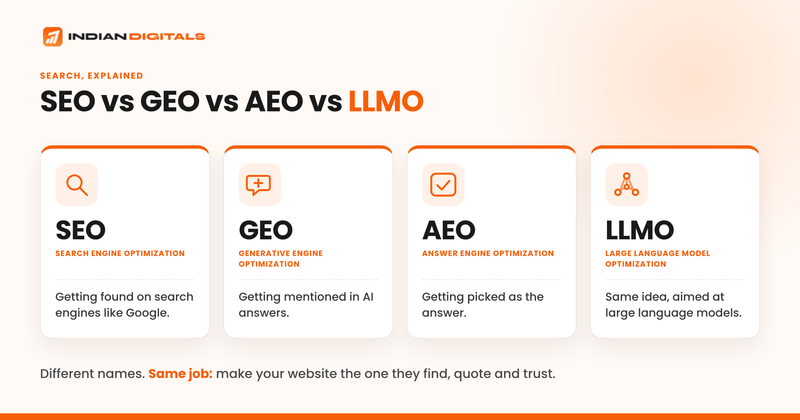
Not much, honestly.
- **SEO** is getting found on search engines like Google.
- **GEO** ( [generative engine optimization](https://www.indiandigitals.com/blog/generative-engine-optimization-geo-for-b2b-companies-a-practical-guide)) is getting mentioned in AI answers.
- **AEO** (answer engine optimization) is getting picked as the answer.
- **LLMO** is the same idea, aimed at large language models.
The names keep changing. The work underneath barely does. You need clear, useful, well-organized content on your own website. That's the whole job.
If you already do good [SEO](https://indiandigitals.com/services/seo), you're most of the way there. If you don't, AI search will make the gap more obvious.
## **A quick story**
A founder once told us, "We post on LinkedIn every day. Why aren't we showing up anywhere?"
We looked at his website. It had a homepage, an about page and a contact form. That's it.
His LinkedIn posts were good. But they were gone in a few days. And when we asked ChatGPT about his category, he wasn't mentioned once.
He wasn't ranking low. He simply didn't exist as far as search engines and AI were concerned.
We hear this a lot. Tons of B2B companies have zero content on their websites.
## **Why LinkedIn alone isn't enough**
Posting on LinkedIn is great. Keep doing it.
But a LinkedIn post has a short life. Most of its reach happens in the first day or two.
A good blog post can bring you traffic and leads for a year, or longer. It keeps working while you sleep. And it gives search engines and AI something to read.
Think of it this way. LinkedIn is where people meet you. Your website is where they, and AI, decide if you're real.
If you want both to work together, we help with [LinkedIn marketing](https://indiandigitals.com/services/linkedin-marketing) and [content strategy](https://indiandigitals.com/services/content-strategy) as one plan, not two separate ones.
## **An empty website means you don't exist**
Search engines and AI both learn about you from your own website.
If it's empty, they have nothing to learn from. As far as they're concerned, you don't exist.
That sounds harsh. But it's the most common reason a good B2B brand is missing from AI answers.
No content means no signals. No signals means no mentions. No mentions means your competitor gets the shortlist spot instead.
## **Try this today: the ChatGPT test**
This takes two minutes.
Open ChatGPT. Ask it about products or services in your industry. Use the kind of question your buyer would type, like "best project management tools for small agencies" or "top B2B content writing agencies."
Now check: does it mention you?
That's the biggest litmus test. Try it on Claude and Perplexity too, since each one answers a bit differently.
If you're not there, don't panic. Most brands aren't. Here's where to start.
## **What to publish first**
You don't need 200 posts. You need the right ones. Start with these four.
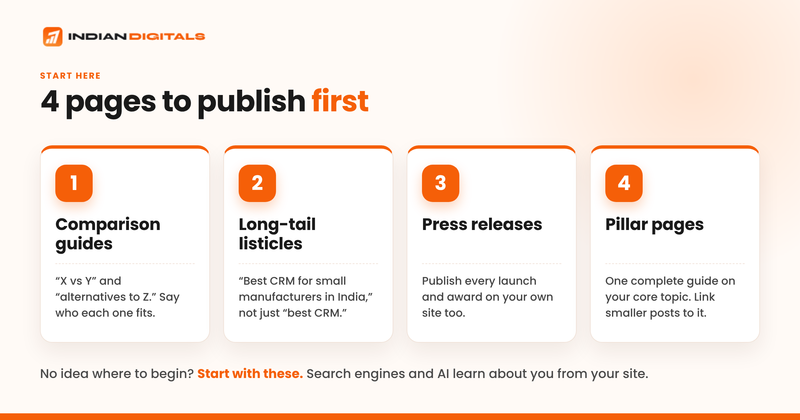What to publish on your website
### **1\. Comparison guides**
Buyers love comparing. "X vs Y" and "best alternatives to Z" are some of the most searched phrases in B2B. AI tools also lean on this kind of content for comparison questions.
Write honest ones. Say who each option is best for. Buyers (and AI) can tell when a page is just a sales pitch.
### **2\. Long-tail listicles**
Think "best CRM for small manufacturing companies in India" instead of "best CRM."
Long-tail keywords have less competition and clearer intent. People who search them are closer to buying. And AI questions are getting longer and more specific, so these pages match how people ask.
This is a big reason we focus on [B2B content writing](https://indiandigitals.com/services/b2b-content-writing) built around the exact phrases your buyers use.
### **3\. Press releases, published on your own site**
Most companies send a press release out and forget it. Then the news page on their site stays empty.
Publish it on your own website too. Every launch, award, partnership and funding update becomes a page that tells search engines and AI who you are and what you do.
### **4\. Pillar pages**
A pillar page is one big, complete guide on a core topic. Then you link smaller posts to it.
For example, if you sell accounting software, your pillar page could be "The Complete Guide to Accounting Software for Small Business." Your comparison guides and listicles all point back to it.
This tells search engines you know the topic deeply. It also gives AI one solid page to pull from.
Need help planning this? Our [content writing](https://indiandigitals.com/services/content-writing) team builds these libraries from scratch.
## **Quick mistakes to avoid**
- **Writing thin content.** A 300-word post with no real answer won't help anyone. Go deep.
- **Chasing every new acronym.** Don't rebuild your strategy each time a new term goes viral.
- **Ignoring local searches.** If you serve a specific city, [local SEO](https://indiandigitals.com/services/local-seo) still matters a lot, and AI tools now recommend local businesses too.
- **Only posting off-site.** Rented space is fine. But own your base.
- **Publishing once and stopping.** Content libraries grow over time. A few strong posts a month beat a burst of ten and then nothing.
## **A simple plan for the next 30 days**
1. Run the ChatGPT test and write down what you find.
2. List 10 questions your buyers ask on sales calls.
3. Turn each one into a blog post or comparison page.
4. Publish your last three press releases on your own site.
5. Pick one pillar topic and start writing it.
6. Check back in 60 days and run the test again.
That's it. No tricks. Just consistent work on the one asset you fully own.
[](https://www.indiandigitals.com/contact/)
## FAQs
Q: What is the difference between SEO and AI SEO?
A: SEO aims to rank your pages in search results. AI SEO, also called GEO or AEO, aims to get your brand mentioned or cited in AI answers. The core work is the same: clear, useful content on your own site.
Q: How do I get my business mentioned in ChatGPT?
A: Publish helpful content on your website, like comparison guides, long-tail listicles and pillar pages. Keep your brand details consistent across the web. Then test regularly by asking ChatGPT questions your buyers would ask.
Q: How long does SEO take to work?
A: Usually a few months to see early movement, and longer for big results. It depends on your competition and how much quality content you publish.
Q: Is SEO dead because of AI?
A: No. AI changed how people search, but search engines are still huge, and AI tools often rely on web content (and sometimes live searches) to answer. Good SEO content helps you in both places.
Q: Is blogging still worth it for B2B in 2026?
A: Yes. A strong blog post can send traffic and leads for a year or more, while a social post fades in days. Blogs also feed both search engines and AI tools.
---
This blog is powered by Superblog. Visit https://superblog.ai to know more.
---